
AI marketing is the use of artificial intelligence to make marketing decisions and produce marketing work. In practice it means letting software analyse customer data, predict what someone is likely to do next, and personalise the message they see — at a scale and speed no team could manage by hand.
The term covers a wide range of tools. A model that scores which leads are worth calling is AI marketing. So is a system that writes forty subject-line variants for a campaign, or one that decides which ad to show a returning visitor. What links them is that the software learns patterns from data rather than following rules someone wrote in advance.
How AI Marketing Actually Works
Almost every AI marketing application follows the same three-step shape, whatever the tool or vendor.
It starts with data. Purchase history, website behaviour, email engagement, support conversations, ad performance. The model can only learn from what it is given, which is why data quality matters more than the sophistication of the algorithm.
Then the model finds patterns. It might learn that customers who browse a particular category twice within a week are far more likely to buy, or that a certain phrasing performs better with one audience segment than another.
Finally, something acts on the pattern. An email gets sent, an ad bid gets raised, a product recommendation appears, a lead is routed to a salesperson. This is where value is created — insight that never reaches a customer-facing decision changes nothing.
The Two Kinds of AI in Marketing
Marketers often talk about AI as if it were a single thing. It is more useful to split it in two, because the two kinds solve genuinely different problems.
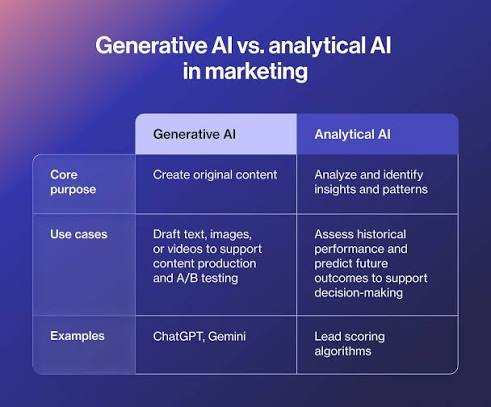
Generative AI: Creating Content
Generative AI produces original output — text, images, video, audio. In marketing it drafts ad copy, writes first versions of blog posts and product descriptions, creates image variations for testing, and generates the volume of creative that A/B testing requires.
Its real strength is removing the blank page. A team that once produced three ad variants can produce thirty, then test which actually works. Tools in this category include ChatGPT and Gemini.
Analytical AI: Finding Patterns
Analytical AI does not create anything. It examines historical performance, identifies patterns, and predicts future outcomes to support decisions.
Lead scoring algorithms are the clearest example: the model looks at which leads converted in the past, finds the attributes they shared, and ranks new leads accordingly. Churn prediction, demand forecasting, segmentation and attribution modelling all work the same way.
The distinction matters when choosing tools. If your problem is that you cannot produce enough creative, generative AI helps. If your problem is that you do not know which customers to prioritise, generative AI will not help at all — you need analytical AI.
Where AI Marketing Is Used Most
Personalisation at Scale
Showing different content to different people based on their behaviour is the oldest promise in digital marketing and the hardest to deliver manually. AI makes it practical: product recommendations, dynamic email content, and website experiences that adapt to the individual visitor.
Customer Segmentation
Traditional segmentation relies on attributes a marketer chooses — age, location, purchase value. Clustering models instead find groups that genuinely behave alike, sometimes surfacing segments nobody thought to look for.
Predictive Analytics
Which customers are likely to churn next quarter? Which leads deserve a call today? What will demand look like in December? These forecasts let teams act before an outcome rather than report on it afterwards.
Content Production and Testing
Generative tools shorten the distance between an idea and a draft. The bigger gain is in testing — when producing a variant costs minutes instead of days, testing becomes routine rather than occasional.
Advertising Optimisation
Most major ad platforms now run on machine learning. Bidding, audience selection and placement are increasingly handled by the platform models themselves, which shifts the marketer job toward feeding those systems good inputs: clear objectives, clean conversion data, strong creative.
Conversational Marketing
Chatbots and assistants handle routine questions, qualify leads, and pass genuine opportunities to people. Done well, response time drops sharply. Done badly, customers get trapped in a loop and leave.
What AI Marketing Genuinely Improves
Speed. Work that took a week — analysing a campaign, drafting variants, re-segmenting a list — can take hours.
Scale. Personalisation that is impossible manually becomes routine. A small team can run communications that previously needed a large one.
Consistency. Models apply the same criteria to every lead and every data point, without fatigue or the bias of whoever happens to be reviewing that day.
Better use of people. When software handles the repetitive layer, marketers spend more time on positioning, strategy and judgement — the parts AI is worst at.
The Limits Worth Taking Seriously
AI marketing is not a solved problem, and the failures are predictable.
Poor data produces poor output. A model trained on incomplete or badly structured data will make confident, wrong predictions. Many disappointing AI projects are data problems wearing an AI costume.
Generated content drifts from your brand. Published without editing, AI copy tends toward the generic. It reads like everyone else because it was trained on everyone else. Human editing is not optional.
Privacy and regulation. Personalisation depends on personal data, which sits under GDPR, CCPA and similar rules. Consent, retention and transparency need deciding before a campaign launches, not after a complaint.
Over-automation. Not every touchpoint should be automated. High-value customers, complaints and sensitive conversations usually need a person, and removing the human option often costs more than the efficiency gained.
Models are opaque. When a system scores a lead poorly, it rarely explains why. For regulated industries, and for teams that need to justify decisions, that opacity is a real constraint.
How to Start Without Wasting a Budget
Begin with a problem, not a tool. Wanting to use AI leads nowhere. Noticing that your sales team wastes time on leads that never convert points directly at lead scoring.
Check your data first. Before buying anything, ask whether the data the tool needs actually exists, is accurate, and is accessible. This single step prevents most failed projects.
Run one narrow pilot. Pick a single use case, define what success looks like numerically, and run it long enough to judge. Broad rollouts before proof tend to produce expensive disappointment.
Keep people in the loop. Review generated content before publishing. Spot-check model decisions. Treat automation as a draft that a person approves, at least until the system has earned trust.
Measure against the old way. The question is never whether the AI worked, but whether it beat what you were doing before. Without that comparison, you cannot tell.
Where This Is Heading
The direction is toward AI that acts rather than just advises — systems that adjust campaigns, reallocate budget and tailor journeys with less step-by-step instruction. As that happens, the marketer role shifts again: less manual execution, more defining objectives, setting constraints and judging whether the output is any good.
What does not change is the foundation. AI marketing amplifies whatever strategy it is given. Pointed at clear positioning and clean data, it compounds the advantage. Pointed at a confused strategy, it produces confused work faster. The technology is a multiplier, not a substitute for knowing what you are trying to say and to whom.

